 Project 11
Project 11: 3D Scenes
The assignment this week has two parts. First, demonstrate use of the 3D turtle and build some interesting 3D shapes. Second, pick one significant extension of the system and design and implement your own solution. The list of extensions given below is not all-inclusive, and you should feel free to pick your own. The key is to demonstrate how you can define a task, design a solution, and implement the solution so the computer can complete the task. Efficient and elegant solutions are the optimal outcome.
Tasks
- Make Four 3D Shapes
Make at least four new 3D shape classes, like a box or a house. Use strings, just like you did for the square and triangle classes. You can use parameterized strings, which should make the task easier.
An image with examples of all of your 3D shapes is required image 1. In this image, demo at least 2 different styles.
- Create a 3D Scene Using the 3D Shapes
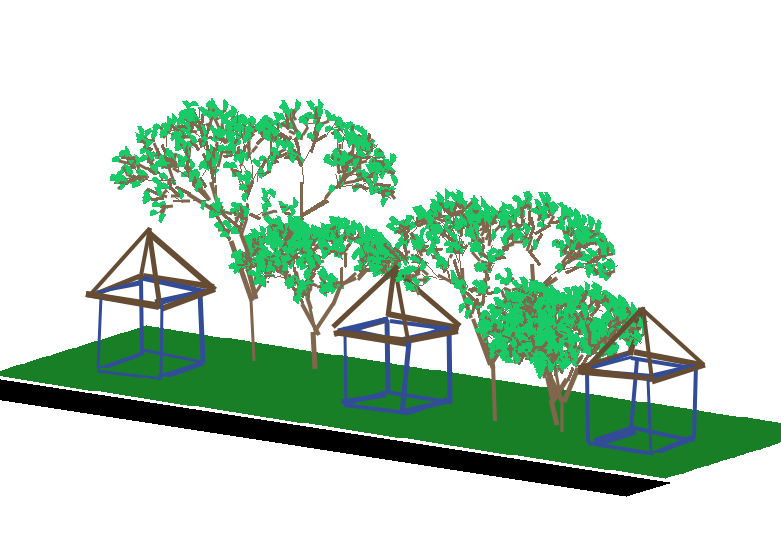
Make a 3D scene that incorporates your shapes. Your scene can be abstract, artistic, or realistic. Try to maximize the complexity of the scene, while minimizing the amount of code you have to write. For this task, spend some time thinking about your design before you start to code. Talk about your design in your writeup. Note that complexity may not mean lots of objects. Having lots of small stuff will slow down the interactive viewing.
Two images of your scene from different points of view are required images 2 and 3.
- Do Something Interesting
Do something interesting within this context. Make sure you have a clear description of the task. Design a solution you think will work and then implement the solution. The difficulty of the task is not necessarily as important as following a structured process so you understand what the computer needs to do and how to do it. The design of your solution should be part of your report.
Note: you can choose something from the list of extensions, if you would like. If it's really good, it may get you some extension points as well.
An image demonstrating your solution is required image 4.
Extensions
Extensions are your opportunity to customize your project, learn something else of interest to you, and improve your grade. The following are some suggested extensions, but you are free to choose your own. Be sure to describe any extensions you complete in your report. Include pictures.
- Design multiple 3D, parameterized L-systems. Explain the goal of your design and the elements of the L-system that achieve it.
- Pick an NPR style you like but have not yet implemented. Try Jackson Pollack, for example. Make sure the style extends to 3D. (And, just like last week, the dashed and broken styles don't count.)
- Pick some semi-complex shapes and create efficient designs for them. Wire frame geodesic spheres, or dodecahedrons, for example, are interesting shapes with lots of regularity to them.
- Make an additional scene.
- Use the 3D turtle to create an interactive tool for creating L-systems. Take user input from the command line to define base strings and rules.
- The 3D turtle allows you to attach a function to the right mouse button. Whenever the user clicks the right mouse button in the window, the function gets called. How could you use this to make an interactive program? (Try running the 3D turtle python file directly and use the right mouse button, then look at the test method to see how it's done.)
- Design a generic shape class that reads its string from a file. See if you can combine this with some interactivity so the user can edit a string and then look at the result immediately.
Submit your code
Turn in your code (all files ending with .py) by putting it in a directory in the Courses server. On the Courses server, you should have access to a directory called CS151, and within that, a directory with your user name. Within this directory is a directory named private. Files that you put into that private directory you can edit, read, and write, and the professor can edit, read, and write, but no one else. To hand in your code and other materials, create a new directory, such as project1, and then copy your code into the project directory for that week. Please submit only code that you want to be graded.
When submitting your code, double check the following.
- Is your name at the top of each code file?
- Does every function have a comment or docstring specifying what it does?
- Is your handin project directory inside your Private folder on Courses?
Write Your Project Report
If you haven't already made a new page for this report on the wiki, then make one now (Log into the wiki, goto your Personal space by selecting "Personal Space" on the menu under the Person icon, then make the page using the "Create" button. Put the label cs151f19project11 in the label field on the bottom of the page. But give the page a meaningful title.
Your intended audience for your report is your peers not in the class. From week to week you can assume your audience has read your prior reports. Your goal should be to be able to use it to explain to friends what you accomplished in this project and to give them a sense of how you did it.
Your project report should contain the following elements.
-
A brief summary of the project, in your own words. This should be no more than a few sentences. Give the reader context and identify the key purpose of the assignment.
Writing an effective abstract is an important skill. Consider the following questions while writing it.
- Does it describe the CS concepts of the project (e.g. writing well-organized and efficient code)?
- Does it describe the specific project application?
- Does it describe your the solution or how it was developed (e.g. what code did you write)?
- Does it describe the results or outputs (e.g. did your code work as expected)?
- Is it concise?
- Are all of the terms well-defined?
- Does it read logically and in the proper order?
- A description of your solution to the tasks, including images you created (including the required images or videos mentioned above). This should be a description of the form and functionality of your final code. Note any unique computational solutions you developed or any insights you gained from your code's output.
- A description of any extensions you undertook, including text output or images demonstrating those extensions. If you added any modules, functions, or other design components, note their structure and the algorithms you used.
- The answers to any follow-up questions (there will be 3-4 for each project).
- A brief description (1-3 sentences) of what you learned. Think about the answer to this question in terms of the stated purpose of the project. What are some specific things you had to learn or discover in order to complete the project?
- A list of people you worked with, including TAs and professors. Include in that list anyone whose code you may have seen, such as those of friends who have taken the course in a previous semester.
- Put the label cs151f19project11 on your wiki page.